
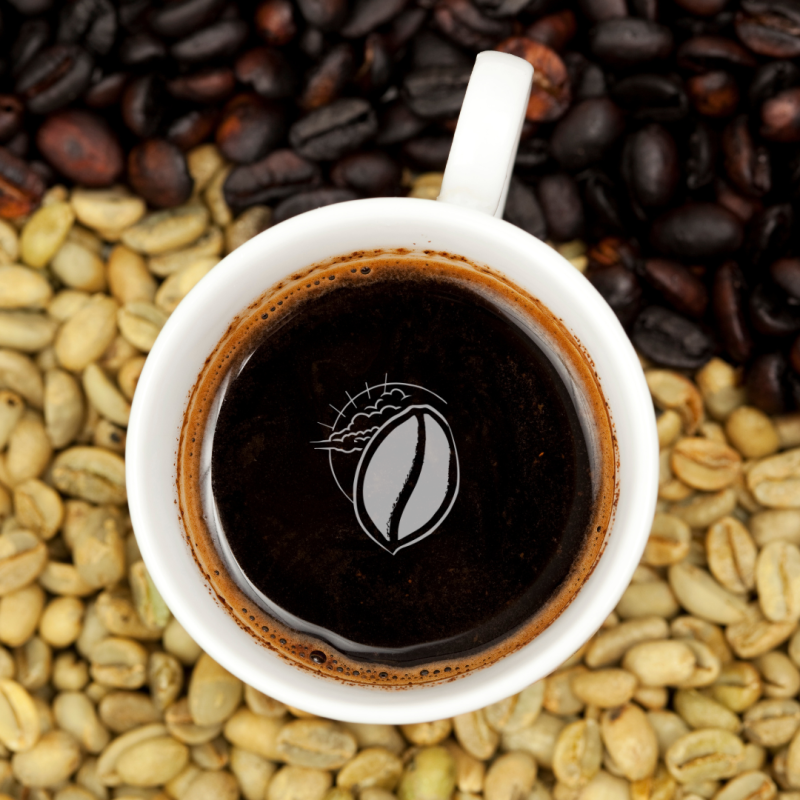
There is only one place on Earth where coffee still grows wild, on its own, planted by no one: the forests of southern Ethiopia. There, in the shade of tall trees, arabica lived before the word "coffee" existed. Every bean in the world — from Brazil, Colombia, Vietnam — descends from those wild trees. Ethiopian specialty coffee isn't one more origin on the shelf. It's a homecoming.
Ethiopian specialty coffee — where the wild comes from
"Heirloom" isn't a variety. It's a word covering thousands of local, uncatalogued varieties that appeared on their own in the forest over thousands of years. No one designed them. They grew the way the mountain wanted. That's why a cup of Yirgacheffe gives you jasmine, bergamot, black tea and an acidity that sparkles — not because an agronomist decided, but because the forest wrote the recipe first.
That's the kind of story we live here, between flame and wind. A wild bean demands a roast that doesn't tame it.
Ethiopian specialty coffee in 2026 — the year of naturals
This year, Ethiopia turned the market upside down. The price of coffee cherry shot up overnight, so sharply that one exporter put it plainly: "There's more money than coffee." Washing coffee takes capital up front, so many farmers chose to dry the whole cherry in the sun, at home. The result: washed lots grew scarce, and naturals — coffee dried with the fruit on, denser, fruitier, wilder — became the star of 2026, the year of naturals.
For us, roasting in the open air, that's good news. The Ethiopian natural doesn't want laboratory precision. It wants real fire and a sky that gets involved.
What the Brussels sky does to an Ethiopian specialty coffee
A natural Ethiopian lot is already brimming with sugar and fruit. When Golden breathes in late July, the heavy summer air sitting over the market, the beans give way fast — and we put the flowers up front: apricot, raspberry, a tea-like finish. On a colder, sharper morning, the same beans close up, deepen, pull toward cocoa. Same origin, two cups that don't resemble each other. The forest wrote the beginning; Saturday's sky writes the end.
That's what an indoor roastery — air-conditioned, fixed recipe — cannot do. We don't tame the wild bean. We keep it wild all the way through.
How to brew it
The Ethiopian natural shines as filter — V60, Chemex, anything that lets the flowers breathe. Medium-fine grind, water just off the boil, and drink it black, no milk. The first sip is floral; as it cools, the ripe fruit shows up. A coffee that changes in the cup, exactly like the weather that roasted it.
See the current Ethiopian coffee lot or the full selection — roasted fresh, on the weekend.
Where to find Ethiopian specialty coffee, freshly roasted
We roast only on Saturday and Sunday, in the open air, at Marché de l'Abattoir, exit of the Manufakture car park, Anderlecht. Roast date written on the bag. Small lots disappear fast — those who know, know.
Coffee was born wild in an Ethiopian forest. We keep it wild all the way to your cup.
Brut. Sauvage. Imprévisible.
---
