
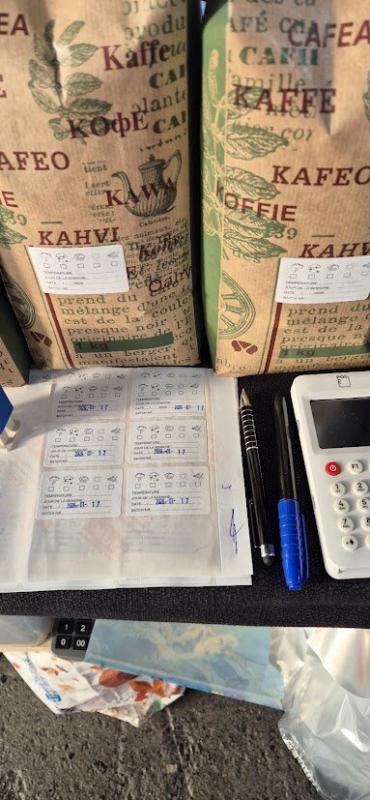
Saturday morning at Marché de l'Abattoir, two trays come out of Golden an hour apart. One holds Ethiopian beans, the other Vietnam robusta. The difference between arabica and robusta in the cup already shows up there, in the tray: the robusta bean is smaller, rounder and heavier in your hand. What happens in the cup starts with what those beans carried before the drum.
The difference between arabica and robusta in the cup starts with sugar and fat
A green arabica bean holds roughly 15 to 17.5% fat and between 6 and 11% sugars. Robusta sits lower on both counts: roughly 10 to 12.6% fat and between 3 and 7% sugars.
Sugars are the raw material for browning and caramelisation, which means they are the raw material for the chocolate notes we wrote about last week. With less sugar inside the bean, the same reaction has less to work with. That is where the cup profile comes from: the Ethiopian lot gives white flowers, citrus and honey, with bright acidity. The Vietnam robusta gives cocoa, sweet spice and toasted hazelnut, with firmer bitterness.
Fat explains the other half. It carries body across your palate and it builds the thick crema on an espresso.
Caffeine widens the difference between arabica and robusta in the cup: almost double per gram
On a dry weight basis, arabica sits between 1.2 and 1.5% caffeine. Robusta sits between 2.2 and 2.7%. At the same weighed dose and the same coffee to water ratio, a cup of robusta hands you almost twice the caffeine.
That is where this differs from yesterday's piece on dark roasted coffee. Roast colour moves the caffeine in your cup a little. Species moves it a lot.
What Laurent does at the fire for the difference between arabica and robusta in the cup
The robusta bean is denser and harder, and it takes colour more slowly because it has less sugar to caramelise. Colour in the tray misleads you, so Laurent works by smell and by the crack.
Here is how the coming weekend reads in the Anderlecht forecast: Saturday 19 September stays dry, 16 to 22°C (61 to 72°F), humidity falling from 71% at 8am towards 57% at 4pm, gusts up to 53 km/h (33 mph). Sunday 20 September brings around 11 mm of rain and 82% average humidity.
On Saturday the gusts steal heat from under the drum, so Laurent keeps the flame higher and watches the drop point more closely. On Sunday, with water in the air, the drying phase runs longer, so he starts the fire stronger at charge. The flavour target holds on both days, and the road to it shifts.
The espresso blend works the difference between arabica and robusta in the cup: 20% robusta
The common roastery ratio for espresso is 80% arabica and 20% robusta. Those 20% bring body and crema, and the arabica keeps the aromatic range open. Bon Café, our house blend, follows the same logic.
The home test that shows you the difference between arabica and robusta in the cup
Take 15 g of each coffee, the same grind setting, 250 ml water at 93°C (200°F), the same method and the same brew time. Drink them back to back, arabica first.
What you are looking for: robusta presses on the middle of your tongue and stays there longer, arabica lifts acidity at the front and clears quickly.
Settings that work for us:
- Robusta espresso: 18 g in the basket, 36 g in the cup (1:2 ratio).
- Robusta filter: 14 g to 240 ml (about 1:17), because the bitterness dilutes well.
- Ethiopian arabica filter: 15 g to 240 ml, water at 94°C (201°F).
Troubleshooting:
- Robusta comes out bitter and rubbery: one step coarser on the grinder and water at 90°C (194°F).
- Arabica comes out watery and sour: one step finer and water at 94°C.
- Change one variable per day, then drink two identical mornings before the next change.
The scoop trap: the robusta bean is denser, so a level scoop of robusta weighs more than a scoop of light roasted arabica. The figures are in the piece on how many grams are in a scoop.
What happens on the plantation before the difference between arabica and robusta in the cup
On 27 August 2026, Aaron P. Davis, Akshay Dashrath and Justin Moat published a review in the journal Sustainable Development (DOI 10.1002/sd.71568) that questions the idea of robusta as a self-sufficient climate answer. The big robusta regions in Brazil, Vietnam and India often lack the climate the plant actually needs and lean on irrigation, and water scarcity becomes the real limit. The authors call for structural change across the industry.
The port of Antwerp holds more than 250,000 tonnes of green coffee and serves as an official ICE delivery point for arabica and robusta contracts. Robusta travels through the country by ship, then rarely reaches a cup on its own.
Both come out of Golden in 250 g bags: the Vietnam robusta and the Ethiopian arabica. You will find them in the shop or on the table at the stand.
Come by around 9am on Saturday at Marché de l'Abattoir, by the Manufakture car park exit, Anderlecht. We roast on Saturday and Sunday. I will put the two cups side by side and you tell me which one presses harder on your tongue.
Brut. Sauvage. Imprévisible.
(Roughly 885 words)
---
