
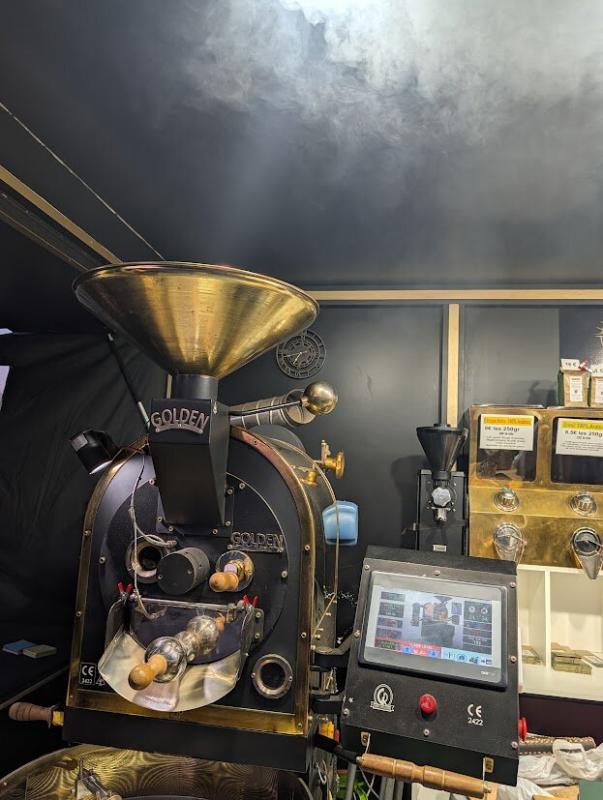
In the morning at the Marché de l'Abattoir, the first part of a gas coffee roaster in cold weather to feel the chill is the cylinder. It feels it before Golden's drum and before the green beans. The gas sits inside as a liquid and leaves for the burner as vapour, and how fast it evaporates depends on how warm the surrounding air is. This weekend stays mild, but the nights are getting colder, and at an open-air roastery in Anderlecht, coffee roasting in autumn starts now, at the cylinder.
We wrote about Golden's longer preheat last week, in the piece on the three weather variables. Today we stay with the gas.
What cold does to the cylinder of a gas coffee roaster in cold weather
To turn from liquid into vapour, gas needs heat. It takes it from the remaining liquid and from the cylinder's metal walls. On a warm afternoon, the surrounding air hands that heat back quickly. On a cold morning, it hands it back slowly.
Why does gas cylinder pressure drop in cold weather? Because pressure follows temperature. Take propane, since its tables are public: around 25 degrees it pushes at roughly 10 atmospheres, around 1 degree at roughly 5. Between a summer afternoon and a frosty morning, the pressure halves.
The regulator keeps the flame steady as long as the cylinder has pressure to spare above it. In the cold, and especially after an hour of continuous fire, that margin gets thin. The cylinder cools itself because of the gas evaporating, and you can see it: dew forms on the wall. Frost on a gas cylinder, when it's very cold, is the same sign, only stronger.
Why the first batch is the most sensitive
On the first batch of the day, everything starts cold: the cylinder, Golden's metal, the beans. Later the air warms up and the cylinder recovers. That's why the gas problem almost always shows up in the morning, right when Laurent needs the most fire to heat the drum.
How we prepare the gas coffee roaster in cold weather before the first batch
Cold asks for a few simple things, all before the first bean goes in:
- A full cylinder for the first batch. A full cylinder holds more liquid, so it cools more slowly than one that's nearly empty. The opened one does its job better in the afternoon, when the air has warmed up.
- A sheltered cylinder. It stands raised off the cold concrete and out of the wind, so the air around it can give heat back.
- No direct heat on the cylinder. You never warm a cylinder with a flame, a space heater or against the drum. It's a safety rule, with no exceptions.
- The flame read by eye. A flame that shrinks at the same valve position shows the pressure has dropped, usually before it shows on the thermometer. Laurent watches it and corrects the fire.
The flavour target stays the same every morning. Only the road to it changes: Laurent reads the air, the gas and the flame, and adjusts fire and time on Golden. That's the variation we wrote about when we compared batches roasted on the same weekend.
What a gas coffee roaster in cold weather teaches you about your camping stove
For tonight, the Belgian weather service (RMI) expects lows dropping locally to 6 degrees in the Ardennes. If you're planning a coffee by the tent or on a bench in the woods, a camping gas canister in cold weather behaves exactly like a gas cylinder in cold weather, only faster.
Camping canisters usually hold butane, isobutane and propane in varying proportions. Butane boils at around minus 1 degree, so near freezing it gives off almost no vapour. Isobutane holds out to around minus 12, propane to around minus 42. A canister heavy on butane can burn well at first and then weaken long before it's empty, because the propane in the mix goes first.
What you can do tomorrow morning:
- Keep the canister in your jacket's inside pocket for 15 to 20 minutes before you screw it on.
- Stand it on a piece of foam or a small board, away from the cold ground.
- For autumn and winter, buy a winter-mix canister, with more propane or with isobutane.
- If the flame drops after a few minutes, hold the canister in your hands for a minute. Never on the fire, never near the flame.
For coffee on a camping stove with a folding pour-over cone: 15 g coffee, medium grind, 250 g water just off the boil, poured in three goes, about 3 minutes in total.
Come and see up close how a gas coffee roaster in cold weather gets ready
If you're at the Marché de l'Abattoir this weekend, by the Manufakture car park exit in Anderlecht, look at the cylinder first, then at the flame. We roast on Saturday and Sunday. Ask at the stand which cylinder Laurent puts on for the first batch, and why. The weekend's batches are also in our coffee shop.
Brut. Sauvage. Imprévisible.
