
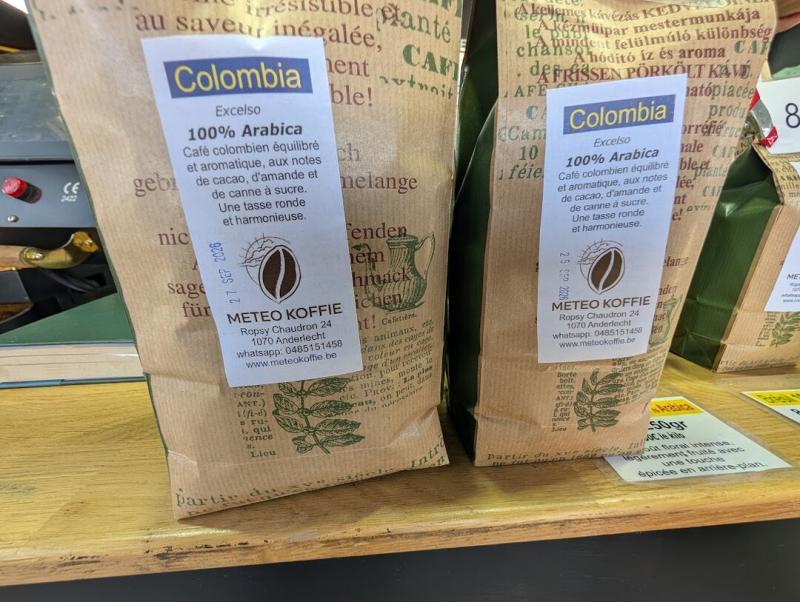
On Saturday you bought a bag from us. You liked it, so on Sunday you picked up another one, same origin. At home the second one tastes a little rounder or a little brighter. Same coffee, different taste? Differences between coffee batches exist at every roastery, and with coffee roasted outdoors in Anderlecht, part of the cause shows up in the weather forecast. Below: why does the same coffee taste different from bag to bag, how big the gap is allowed to be, and how to compare two bags of coffee at home in fifteen minutes.
Where differences between coffee batches come from
There are three sources, and only one of them is the air.
The green bean. Inside one sack, every bean has its own moisture and density. A batch of a few kilos is one handful from that sack, the next batch is another handful. The gap is small, and every roaster in the world lives with it.
The drum. Golden's metal stores heat as the day goes on. The midday batch starts in a warmer drum than the 9 a.m. batch. We covered this in detail in the piece on coffee roasted in the morning and in the afternoon.
The day's air. On Saturday 26 September, Anderlecht was at 14.5°C (58°F) at 8 a.m., and by 10 humidity had climbed from 63% to 77% while the wind swung from south-west to north. On Sunday, at the same hours, temperatures were almost identical (14.1°C, 57°F at 8 and 16.5°C, 62°F at 10), but humidity went the other way: 84% at 8, 64% at 10, with an easterly wind that turned south. Both days stayed dry.
Two equally cool mornings: on Saturday the air grew damper while we worked, on Sunday it dried out. So Sunday's first batch started in damper air than Saturday's first batch, and by the 10 a.m. batches it was the reverse. Laurent reads that for every batch and sets the flame and timing to match.
Controlled variation: how big differences between coffee batches may be
Controlled variation in coffee roasting means the variation is real and the roast stays under control anyway. Three things stay fixed for every batch: the origin, the target (a batch meant for filter or for espresso), and the point where Laurent ends the roast, which he reads in the bean colour, in the smell, and in the time since first crack. What moves is the road there: how much flame, how many minutes, how fast the temperature climbs. Laurent changes the road precisely so he lands in the same place.
The taste stays in the same family. Sometimes sweetness or acidity steps forward a little.
Indoor roasteries have the same problem. On the blog of Cropster, software used by many roasters, roaster Anne Cooper says the temperature and humidity of the roasting room have a huge impact on consistency, and that she adjusts the break between batches to the day's conditions and to the batch number. Our room is the sky over the market, which Laurent reads in Friday's forecast.
The triangle test: check differences between coffee batches at home
For the question "is this really different, or am I imagining it?", tasters use the triangle test, described in the ISO 4120 standard. A triangle test for coffee works fine in a kitchen.
1. Take two bags of the same origin, roasted on different days. Wait until both are in the right window for your method (for filter, at least 4 days after the roast date; details in our guide to resting coffee). 2. Ask someone to make three identical cups: two from bag A, one from bag B. Same recipe for all three: 15 g of coffee to 250 ml of water at 93°C (199°F), same grind, same time. 3. They write what's in each cup on a note underneath and shuffle the cups on the table. You don't watch. 4. Taste all three, let them cool a little, taste again. Point to the cup that's different. 5. Repeat three times, with the odd cup in a new spot each round.
Guessing gets you one right in three. If you find the odd cup three times out of three, the difference is real and worth describing: sweeter, brighter, fuller. If you find it once, the batches sit inside their window, and what you noticed that first morning came from the brew or from the age of the bag.
What to do when you taste differences between coffee batches
Before blaming the batch, check the age of each bag and your brew.
- The second bag tastes thin and sour: count the days. If it's too fresh for your method, give it two or three more days. If it's in its window, grind one step finer.
- The second bag tastes more bitter and dry at the finish: grind one step coarser and drop the water to 90°C (194°F).
- Change one variable per morning. Change two at once and you won't know which one helped.
- Write the roast day on the bag, Saturday or Sunday. After three or four bags you'll know which day you prefer and can ask for it at the stand.
Run the triangle test with two of our bags and tell us the result. Our roastery at Marché de l'Abattoir is there every Saturday and Sunday, by the exit of the Manufakture car park, Anderlecht. Ask Laurent what the air was like on the morning of your batch and what he changed on the flame. Our coffees are also in the online shop.
Brut. Sauvage. Imprévisible.
