
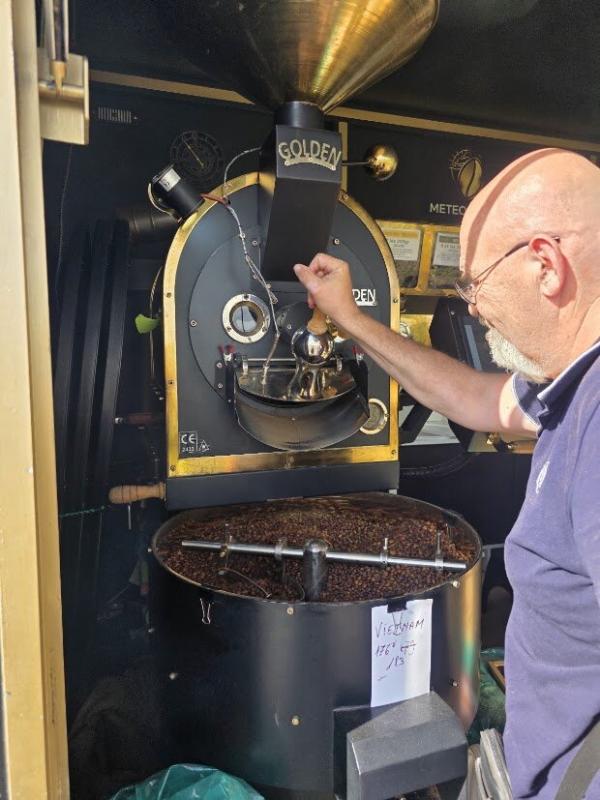
On Saturday at 8 am, the forecast for Anderlecht says 9 degrees and 87% humidity. When you roast outdoors, as we do at the Marché de l'Abattoir, the roasting flame in cold weather is the thing you watch for the whole batch. Instinct says: it's cold, turn the fire up. That instinct is exactly how a coffee gets spoiled.
The gas cylinder, which feels the cold first, got its own piece last week. Today we stay with the flame and what it leaves on the beans.
Roasting flame in cold weather: where the heat goes
Golden is a metal drum heated by a gas flame. Hot metal gives heat to the surrounding air all the time, and that loss grows with the gap between the metal's temperature and the air's. At 9 degrees the drum loses more than at 20. Part of what the flame sends goes into the market air before it reaches the beans.
The cold also shifts through the day. On Sunday the forecast gives 8 degrees at 7 am, 11 at noon and 14 around 3 pm. As the air warms, the loss shrinks. A setting that suits the first batch is too much for the noon batch if nobody touches it. In outdoor coffee roasting in the cold, the correction changes from batch to batch, sometimes inside one batch when a gust comes through. Temperature is also only one of the numbers we read in the morning, as we showed on Monday.
Roasting flame in cold weather and the mistake at charge
When green beans drop into a drum that is too hot, their surface takes heat faster than it can pass it inward. A green bean is dense and still moist, so heat moves through it slowly. Push the fire to "catch up" with the cold and you get two defects every roaster knows:
- tipping: the tips of the bean darken until they are nearly black;
- scorching: burnt spots or patches on the face of the bean, where the metal was too hot.
Drum roasters all say the same thing: the damage happens early, at charge, even though you only see it at the end. In the cup, burnt or ashy notes sit on top of a coffee that could have been good.
Laurent reads the air before the first batch and corrects fire and time on Golden in small steps, eyes on the gas roaster flame and on the colour of the beans. The taste target stays the same as on a 20 degree morning. Getting there just takes more small corrections.
Roasting flame in cold weather on your own bag: the 2 minute test
You can check this on any bag of coffee, ours or anyone else's:
- spread 20 to 30 beans on a white sheet, in daylight;
- look at the ends: coffee beans with burnt tips, black on an otherwise brown bean, means tipping;
- flip them to the flat side: scorch marks on coffee beans, dark and irregular, mean scorching;
- one or two marked beans can happen to anyone; if half your handful shows them, the cause is the fire during roasting.
On a very dark roast these signs are hard to see, because the whole bean is dark. There, taste helps more. If the cup tastes of ash and the beans carry the signs, the cause sits in the beans, and changing the grind won't take it out. Use that bag for milk drinks, where milk covers part of the burnt notes, and next time look at the beans before you buy.
Like the roasting flame in cold weather, at home: sour espresso in the morning
The group head of an E61 machine is a piece of chrome-plated brass weighing about 4 kg. Pull your first shot 10 minutes after switching on and the water gives its heat to the still-cold metal, reaching the coffee a few degrees under target. The result is a sour espresso in the morning, thin, even though dose and grind are right.
For an E61, machine retailers (Clive Coffee, for one) count 20 to 30 minutes of warm-up after switching on. In a cold kitchen, aim closer to 30. If in October only your first espresso is sour and the rest are fine, leave the grinder alone. Switch the machine on earlier. Small thermoblock machines heat faster, so check the manual.
Roasting flame in cold weather at Golden this weekend
Today's forecast (Open-Meteo, Friday 9 October): Saturday, 9 degrees at 8 am, 87% humidity, gusts up to 45 km/h and 2.1 mm of rain over the day. Sunday, 8 degrees at 7 am, 11 at noon and 14 in the afternoon, gusts up to 39 km/h, hardly any rain. Laurent will read each morning on its own.
If you come by the Marché de l'Abattoir, watch Golden's flame at the first batch and again at the noon one. Pick up a few beans too: now you know what to look for. Coffee roasted in Anderlecht over the past weekends is also in the coffee catalogue.
Find us Saturday and Sunday at the Marché de l'Abattoir, by the Manufakture car park exit, Anderlecht.
Brut. Sauvage. Imprévisible.
