
You drink a coffee from Ethiopia and taste lemon, white flowers, sometimes peach. The bag holds nothing but roasted beans. Fruity Ethiopian coffee gets its taste from three places: the mountain it grew on, the variety of the plant and the way the farmer took the bean out of the cherry. Roasting then decides how much of that fruit reaches your cup. Below you'll find where each note comes from, and a simple test that tells you whether the acidity in coffee is fruit or a brewing mistake.
Where fruity Ethiopian coffee comes from: mountain, variety, processing
Altitude
Our Ethiopian lot grows at 1,800 to 2,200 metres. Up there the nights are cold and the cherry ripens slowly. The bean has time to build up sugars and acids, and those acids are what your tongue reads as fruit: citric acid leans towards lemon and orange, malic acid towards green apple. Altitude is the first source of fruity Ethiopian coffee.
The old varieties
Arabica was born in the forests of Ethiopia, where a huge number of local varieties still grow mixed together in the same garden. On labels they share one name: "heirloom". Varieties 74110 and 74112 were selected in the 1970s at the Jimma research centre for their resistance to a disease of the cherry. Roasters who work with them describe floral and peach notes.
Washed or natural Ethiopian coffee
This is where most flavours part ways. With washed Ethiopian coffee, the pulp comes off before drying, and the cup keeps citrus, white flowers, sometimes a hint of tea. With natural Ethiopian coffee, the whole cherry dries with the bean inside, and the taste moves towards ripe fruit: blueberry, strawberry, jam. Our lot is washed. Its product page lists white flowers, citrus, honey.
What roasting does to fruity Ethiopian coffee
You win the fruit at origin, and you can lose it in the roaster. A study from the University of Southern Denmark, published in 2023, measured the acids in French press coffees roasted from very light to light. Citric, malic and chlorogenic acid all dropped with every extra step of roasting, even within that narrow range. Of the acids tested, only citric acid was clearly detectable above the tasting threshold at the concentrations found in coffee.
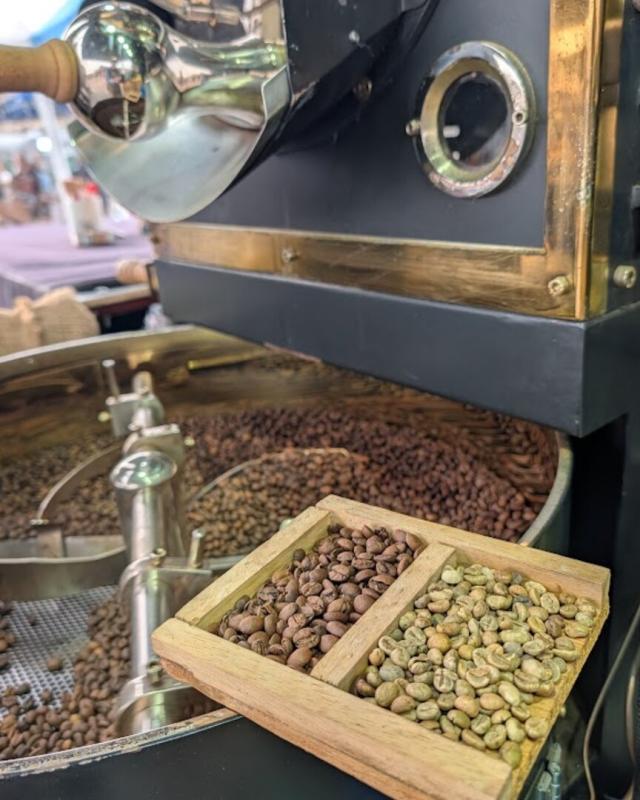
That's why Laurent roasts the Ethiopia medium-light and keeps the end of the roast short. A few dozen extra seconds after first crack push the lot towards caramel and toast, and the citrus fades. Outdoors, that final stretch happens in wind, damp and rain. Laurent reads the conditions and adjusts the fire and the timing on Golden so the lot hits the same target. On Sunday 20 September he held the Ethiopia back until after two o'clock, when the rain stopped. We wrote about that call in the article on the order of roasting batches. Same origin and same flavour target, under a different sky every weekend.
Bright or sour? The fruity Ethiopian coffee test at home
Plenty of people taste fruity Ethiopian coffee for the first time and say "it's sour". Sometimes the cup really is sour, and then the cause usually sits in the grinder or the water.
Start with a filter recipe for Ethiopian coffee: 15 g of coffee to 250 ml of water, water at 93-96 °C, medium grind, total time between 2:30 and 3:30. Taste it and follow the finish:
- The acidity arrives with sweetness (honey, peach, orange) and stays on your tongue after you swallow. That's the fruit, and the recipe works.
- The acidity is sharp and thin, and it vanishes fast, leaving your mouth empty or slightly salty. The coffee is under-extracted, which answers "why does my coffee taste sour". Grind one step finer or bring the water up towards 96 °C, then taste again.
- You only get bitterness and a dry finish. You've gone too far the other way: the grind is too fine or the time too long. We covered that in the article on grinding too fine.
Change one variable at a time. Touch the grind and the water together and you won't know which one fixed the taste.
Choosing fruity Ethiopian coffee from the label
Three lines on the bag tell you which fruit to expect:
1. Processing. "Washed" or "lavé" means citrus and flowers. "Natural" or "nature" means red fruit and sweetness. If the bag doesn't name the process, ask the roaster. 2. Roast level. A light or medium-light roast keeps the citric acid. With a dark roast, the taste comes more from the fire than from the origin. 3. Roast date. Floral aromas are the first to go. With no date on the bag, you can't know how many weeks have passed.
Taste fruity Ethiopian coffee at the Marché de l'Abattoir
Our coffee from Ethiopia is 100% washed arabica. It's coffee roasted outdoors in Anderlecht, on Golden, with a medium-light target. Order it from its page or pick it up on Saturday or Sunday at the Marché de l'Abattoir, at the Manufakture car park exit, in Anderlecht. Taste it next to Golden and tell us which fruit you find.
Brut. Sauvage. Imprévisible.
