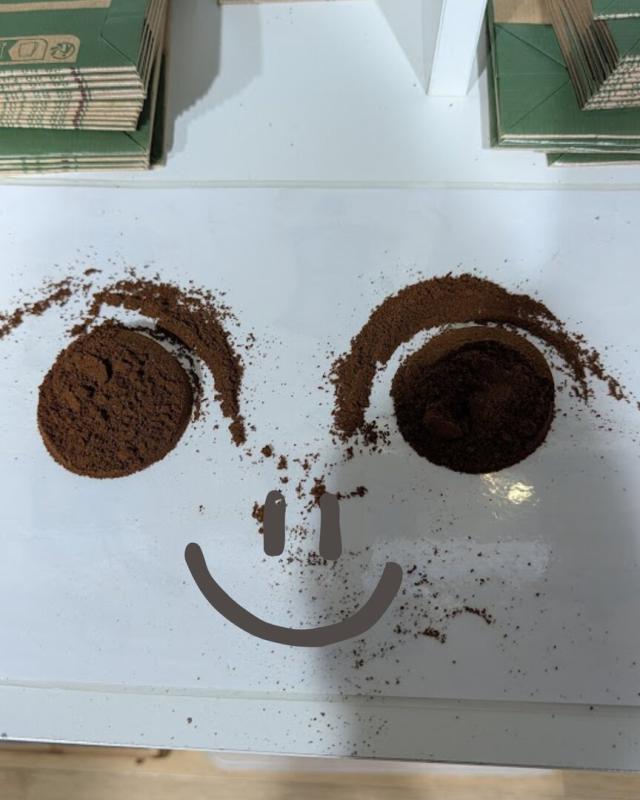
The question comes up at the stall most Saturdays around noon: why does the coffee taste bitter at home when it tasted good at the market. The answer usually sits in the grinder. Coffee ground too fine keeps water on the bed far too long and pulls out the part of the bean that dries your mouth. The useful part: a stopwatch catches it before your tongue does, and the fix is one step on the dial.
What coffee ground too fine actually does
Grind finer and you break the beans into smaller particles that pack into a tighter bed. Water struggles through it, so it stays in contact with the coffee longer. The first seconds give you sweetness and acidity, then the bitter and astringent compounds start coming out. Over extracted coffee finishes dry and leaves the tongue rough, the way black tea does when it sits in the cup too long.
There is a measurement behind this. A study published on 7 March 2024 in Scientific Reports (Samo Smrke, André Eiermann, Chahan Yeretzian, article 5612) shows that the share of fine particles under 100 microns lowers the permeability of the coffee bed. Flow rate drops and extraction takes longer. With the same grams and the same machine, the cup changes because the grinder made more dust.
How the stopwatch spots coffee ground too fine
Three checks with numbers, ready for your next cup:
- Espresso: 18 g of ground coffee, 36 g of liquid in the cup, 25 to 30 seconds from the moment the pump starts. Past 35 seconds with the shot dripping, the grind is too fine. One step coarser, then test again.
- V60 or filter: 15 g of coffee to 250 ml of water at 93°C. All the water should be through by around 3 minutes. If water still sits on top at 4 minutes, go one step coarser.
- French press: the grind looks like breadcrumbs, coarse and uneven, with visible pieces. When the plunger gets hard to push and sludge settles in the cup, you ground too fine.
For a moka pot, fine is right. One rule holds there: level the coffee with your finger in the basket, because tamped coffee turns into a valve that overheats the water and gives you a burnt taste.
Why an outdoor roasted batch gives you coffee ground too fine at the same setting
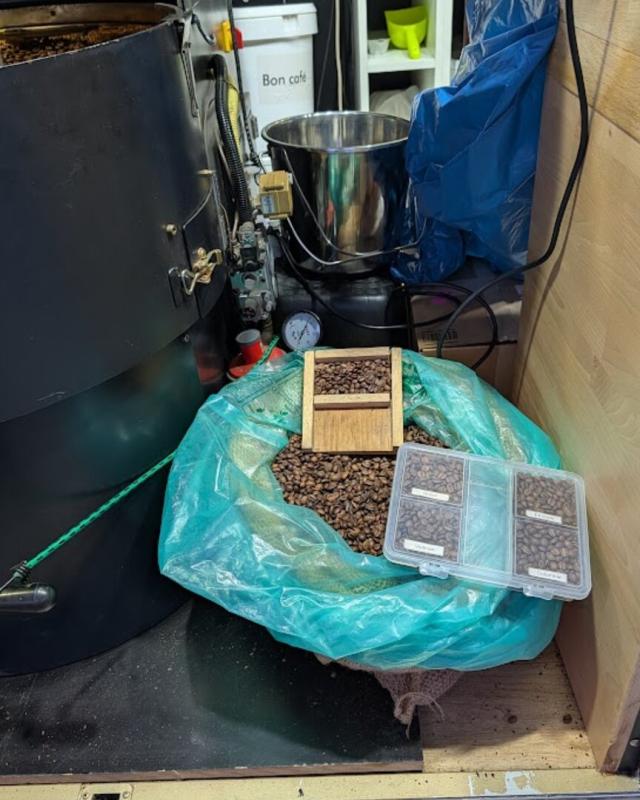
We roast outdoors, with Brussels humidity sitting on Golden's steel. Laurent reads the weather before every batch and adjusts the flame and the time, so two weekends running never hand you identical beans. A bean taken slightly further in the drum breaks more easily and leaves more fines at the same grinder setting. That is where the surprise at home comes from: the setting that worked last month turns into coffee ground too fine on the current batch, with the grinder untouched.
Then there is the gas. A bag bought on Saturday at the Marché de l'Abattoir left the fire two or three days ago, and the bean is still releasing carbon dioxide. That gas swells the bed in the first seconds, pushes water to the edges and slows the flow. Xiuju Wang and Loong Tak Lim showed in Food Research International (2014, volume 61) that the degassing rate of ground coffee depends heavily on grind size: the finer you grind, the faster the gas leaves. So the setting gets found again with every batch, and one stopwatch check on the first cup of this weekend's batch gives you the answer.
Practical rule: with a fresh bag, start one step coarser than your usual setting and move back towards fine after four or five days, once the gas has settled.
Troubleshooting: coffee ground too fine and the opposite
- Bitter and dry on the finish, slow flow: one step coarser.
- Sour, watery, running too fast: one step finer.
- New bag or new batch: run the stopwatch test on the first cup, before blaming the coffee.
- Blade grinder: grind in 3 second bursts and shake it between them. It cuts unevenly and makes a lot of dust, so the bitterness comes back whatever you set. A burr grinder solves it at the root.
- Good on the first cup, bitter on the second from the same bag: weigh every dose on a scale.
Bring your bag to the market on Saturday or Sunday and tell Laurent how you brew at home. He will give you the starting setting for that batch on the spot. Batches and the subscription live on the site, the rest gets sorted out next to the fire.
You will find us at the Marché de l'Abattoir, exit of the Manufakture car park, Anderlecht, on Saturday and Sunday.
Brut. Sauvage. Imprévisible.
---