
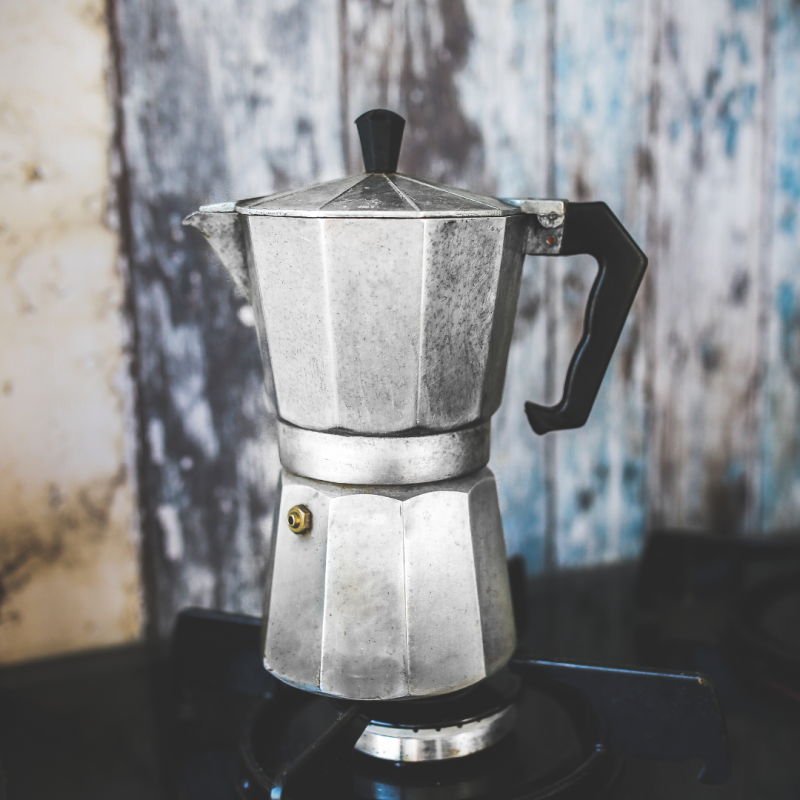
You follow the recipe and still end up with bitter moka pot coffee? Listen to the last 30 seconds. Last Thursday, in our piece on Brazil, Colombia and Ethiopia, we gave one line of advice: take it off the heat at the first hiss. Today, the why, and how to catch the moment.
At Golden, Laurent works a lot by ear: the first crack of the beans tells him where the batch is. The moka pot has its own sound that tells you when to stop. Most people just hear it too late.
Where bitter moka pot coffee comes from: the phase when it screams
A moka pot runs on steam. The water at the bottom heats up, the air and steam above it push down, and the water rises through the funnel, through the coffee, into the top chamber. The pressure stays low, around 1 to 2 bar, far below an espresso.
The trouble comes at the end. Once the water level drops below the tip of the funnel, what rises through the grounds is a mix of steam and very hot water, in bursts. That's the hiss, the gurgle, the "scream".
A team from illycaffè and the University of Trieste (Navarini and colleagues, Applied Thermal Engineering, 2009) called this the "strombolian" phase, a volcanology term for short eruptions in puffs. When you hear moka pot gurgling at the end, you're already in it. That scalding mix pulls harsh flavours out of the grounds fast, and they land in the same cup as the good part from the start. A moka pot left to scream for a minute spoils its own coffee.
The signs before bitter moka pot coffee
Keep the lid open. You see what comes out, and you see it before you hear it.
- At first the coffee flows calmly, dark, like a thread of honey.
- Then the stream turns lighter, towards blond, and big bubbles appear.
- Right after that comes the first hiss.
When to take the moka pot off the heat: the moment the stream starts to turn lighter. To cool the moka pot under cold water, hold the base under the tap for a few seconds, or set it on a cold wet towel. Grab it by the handle with an oven glove: the base is scorching. The cold drops the pressure and the flow stops before the steam phase. A little coffee keeps rising for a moment, that's normal.
The flame under the pot and bitter moka pot coffee
Laurent spends his weekends next to a gas flame. For a moka pot on a gas stove, the rule is simple: the flame stays under the base. If it licks up the sides, it heats the walls and the handle, the water rushes, and the steam phase comes sooner and harder.
- Start with hot water from the kettle, up to just below the valve. The pot spends less time on the heat. We wrote more on water temperature in the boiling water myth.
- Fill the basket level, without pressing. Weigh it full once, so you know the dose of your own pot.
- Medium heat. On induction or an electric hob, the middle setting.
The two-pot test for bitter moka pot coffee
Do it tomorrow morning, with the same coffee, the same grind, the same dose.
- Pot A: stays on the heat until everything stops, hiss included.
- Pot B: comes off the heat as soon as the stream turns lighter, and you cool the base right away.
Pour each into its own cup and wait 3 minutes. Taste B first, then A.
- A is bitter and dry on the tongue, B sweeter: the problem was the ending. Fixed.
- Both are bitter: look elsewhere. Most often the grind is too fine, as explained in grind too fine.
- Both are thin and sour: the grind is too coarse, or you stopped too early.
Troubleshooting bitter moka pot coffee, symptom by symptom
- Moka pot sputtering from the first minute, in jets: the heat is too high. Lower the flame and start with hot water.
- The coffee struggles to rise and the valve whistles: off the heat at once and cool the base. The basket was tamped or the grind is too fine. Next time, level it with a finger and grind one step coarser.
- Burnt taste even though you stopped in time: the flame climbed the walls, or old grounds stayed on the funnel. Rinse the funnel and filter plate after every use.
- Thin, watery coffee: not enough coffee in the basket. Fill it level.
Looking for coffee for moka pot in Brussels? Last Thursday we suggested our Brazil for this method.
Every Saturday and Sunday we roast in the open air at the Marché de l'Abattoir, by the Manufakture car park exit, Anderlecht. Come and hear the first crack at Golden, then run the two-pot test at home and tell us how it went.
Brut. Sauvage. Imprévisible.
